
The franchise in India is booming, with food brands leading the charge. Entrepreneurs are actively eyeing franchise opportunities in India for their proven business models amidst a steady 8–10% annual industry growth. While investors face high initial costs, the demand for food franchises in India—especially Quick Service Restaurants (QSRs)—remains strong. This guide covers everything from KFC and Subway franchise costs to operational gaps, risks, and location strategies.
Best Opportunities For Franchise in India
Food franchises dominate the landscape, highlighted by Domino’s with over 2,450 outlets. While most brands offer extensive training, your choice should be dictated by your available capital: Subway suits emerging entrepreneurs, while KFC is strictly for high-net-worth investors. Moreover, QSRs can yield 10–30% margins, heavily supported by delivery apps. However, master franchise models (like Domino’s and Starbucks) limit individual ownership.
- Domino’s: ₹3.5–4.5Cr, high volume, master franchise only.
- KFC: ₹2.5–4.5Cr, high chicken demand, institutional players.
- Burger King: ₹2–4Cr, rapidly expanding.
- Subway: ₹60L–1.2Cr, moderate entry barrier.
- Pizza Hut: ₹2–4Cr, stable global brand.
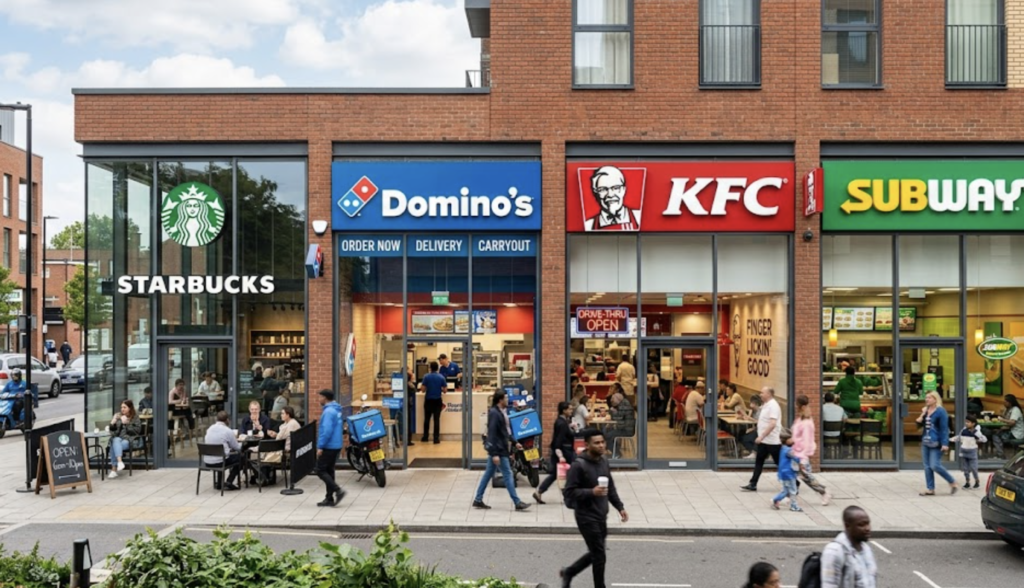
KFC Franchise Cost in India Breakdown
KFC requires a substantial total investment ranging from ₹2.5Cr to ₹4.5Cr.
The initial franchise fee is roughly ₹36L, plus heavy expenses for premium rent, equipment, and a 4–5% ongoing royalty fee. You will need 1,000–1,500 sq ft of space in high-traffic commercial spots.
Monthly operations carry high food costs (around 35%) alongside significant salary and utility overheads.
In India, Master Franchisees like Devyani International run most outlets, making individual ownership very rare. Expect 7–8% net margins after the first year.
Burger King Franchise Cost in India
Starting a Burger King requires ₹2Cr to ₹4Cr.
This includes franchise fees, insurance, and substantial working capital. The brand operates mostly through corporate-owned or master franchise models in India.
You can apply via their official site for a location assessment, but they primarily target urban malls and high-footfall areas, charging around a 5% royalty.
Starbucks Franchise Cost in India (Reality Check)
Starbucks does not offer individual franchises in India. It is exclusively operated through a joint venture with Tata Consumer Products, which runs 400+ stores.
Hypothetical setup costs would be ₹1.2Cr to ₹2Cr, targeting premium malls and airports.
Since there are no individual applications accepted, investors should focus on alternatives like Chai Sutta Bar (₹30–60L)
Domino’s Franchise Cost in India
Domino’s requires an investment of ₹3.5Cr to ₹4.5Cr.
However, Jubilant FoodWorks holds the master franchise rights in India, meaning solo or individual franchises are not available. They rely heavily on delivery volume, though aggregators like Zomato and Swiggy take a 20–30% cut of those specific delivery orders.
Pizza Hut & Subway Franchise Cost in India
Pizza Hut: Requires ₹2Cr to ₹4Cr with a franchise fee of around ₹14L and a 6% royalty. They typically target areas with a population of 100K+.
Subway: A more accessible option starting at ₹60L to ₹1.2Cr. With 3.5–8% ongoing fees, it offers healthy margins and is actively open to individual franchisees across its 900+ Indian outlets.
| Brand | Total Cost (₹) | Fee (₹) | Royalty | Area (sq ft) | Margins |
| Pizza Hut | 2–4 Cr | 14L | 6% | 1000+ | 8–15% |
| Subway | 60L–1.2 Cr | ~6.5L | 3.5–8% | 800–1200 | 30–45% |
Franchise in India Cost Breakdown (Detailed)
A typical food franchise investment in India breaks down as follows:
- Franchise fee: 10–30% of the total (₹5L–50L).
- Setup/equipment: 30–40% (₹20L–1Cr+).
- Working capital: 20% (to cover the first 3–6 months of operations).
- Ongoing costs: Royalty 4–8%, marketing/ads 4–5%, plus GST.
Profit, ROI & Break-Even
Margins range from 7% to 30%, with brands like Subway on the higher end.
The break-even point is typically 18–36 months, with an ROI of 20–60% annually thereafter.
Key factors include location (Tier-1 cities scale faster) and maintaining strong monthly sales.
While delivery apps boost order volume by up to 30%, their commissions eat into about 20% of those specific margins.
Step-by-Step Process for Franchise in India
- Research target brands and market fit.
- Check financial eligibility (e.g., a net worth of ₹1Cr+ is required for larger brands).
- Apply online through official brand channels (e.g., Subway direct).
- Undergo site approval and mandatory training (usually 2–4 weeks).
- Complete FSSAI and GST registration, then launch the outlet.
Is Franchise in India Worth It?
Yes, especially for disciplined investors with capital.
Cons: High entry barriers and heavy dependency on brand operations. Subway is a great moderate-risk entry, while exclusive brands like Starbucks are off-limits.
Pros: Proven brand power and realistic 15–25% overall returns.
Low-Cost Alternatives
Chai Sutta Bar: ₹30–60L.
Jumbo King: ₹30–50L.
Amul: Low risk, driven by constant dairy demand (₹10–30L).
Note: Financing is often available via banks like SBI at 7–9% interest.
Read related post:
EV Charger Franchise in India 2026 – Investment, Profit & ROI Guide
Important Note: This info is not vouch of truth, kindly verify with official sources
FAQ
KFC franchise cost in India? ₹2.5Cr–4.5Cr; mostly restricted to institutional players.
Burger King franchise cost in India? ₹2–4Cr; apply via their official site.
Starbucks franchise cost in India? Not available; exclusively Tata-owned.
Domino’s franchise cost in India? ₹3.5Cr–4.5Cr; run via a master franchise model.
Pizza Hut franchise cost in India? ₹2–4Cr.
Subway franchise cost in India? ₹60L–1.2Cr; best for starters.
Is a food franchise in India profitable? Yes, expect a 2–3 year break-even period with a prime location.